
All 12 Major Keys. Chords, Arpeggio’s, Diatonic (Ionian) scales in every key. 128 Pages.
About
CAGED system for guitar
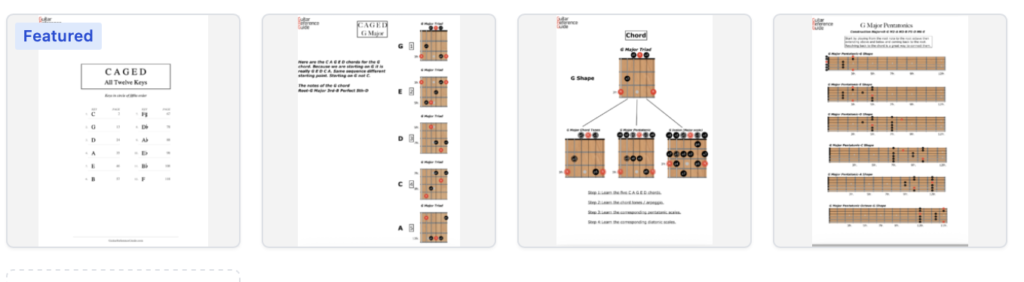
The CAGED system is a way to understand the guitar fretboard by connecting five basic open-chord shapes:
- C shape
- A shape
- G shape
- E shape
- D shape
The key idea is that the same chord can be played in different places on the neck, using these five shapes. This helps you visualize chords, scales, arpeggios, and eventually improvise across the whole fretboard.
Example: C major
A C major chord can appear as:
C → A → G → E → D → C…
These shapes move up the neck and connect to one another. You don’t necessarily play them as open chords; you often use barre chords or partial shapes when moving them.
For example, the E-shape major barre chord gives you a major chord whose root is on the 6th string:
E shape → move it up → barre chord
If you put the root at the 5th fret, that’s A major.
Why CAGED is useful
It lets you:
- Find chord shapes all over the neck
- Locate the root notes quickly
- Connect major scales to chord shapes
- See arpeggios inside each chord
- Improvise without being stuck in one fretboard position
- Understand how rhythm and lead guitar fit together
A simple way to learn it
I’d recommend learning it in this order:
1. Learn the five open chord shapes:
C, A, G, E, D.
2. Learn where the root note is in each shape.
3. Turn the A and E shapes into movable barre chords.
4. Learn how the five shapes connect along the neck.
5. Add the major scale around each shape.
6. Practice playing a chord → its arpeggio → its scale.
If you’re a beginner, don’t try to memorize all five shapes at once. Start with E and A shapes, because they’re the most immediately useful for movable chords.

